Who cares about football? The real attraction of the Super Bowl is the commercials and halftime show!
More than 111 million people watched Super Bowl 2014, aka XLVIII, which is roughly 42 percent
of all adults in the United States. The game was great if you were a Seattle Seahawks fan and not so great if you were rooting for the Denver Broncos, since they were demolished 43-8.
So why would 110 million people watch a lopsided football game? Some were certainly real NFL fans who watched the game because, hey, it’s football. But the average NFL game draws 16.6 million viewers. That means about 94 million were occasional NFL fans or were watching for reasons other than football.
Super Bowl: A Time to Party
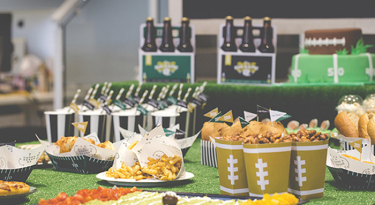
Without a doubt, the Super Bowl has developed into an excellent excuse to party. As evidence, Super Bowl watchers are expected to consume 1.25 billion chicken wings this year and equally impressive quantities of chips, beer, soda and other party food.
But even if you’re in the party mode, you need to be entertained. And that’s where the commercials come in. The ascendency of the Super Bowl to the pinnacle of televised events is a case study in the merging of two powerful forces: the U.S. advertising community and the NLF.
Let’s take an in-depth look at these powerful forces, starting with advertising community.
I
The Powers Behind the Super Bowl: the Ad Community
The advertising community is in the business of promoting any which way they can. It’s really that simple: ads, events, flyers, knock on doors, trail banners behind prop airplanes: do anything and everything possible to promote a client’s products and get consumers to buy.
Madison Avenue supported the NFL from the start, since the games delivered a valuable audience: men. For decades the staple of every game was commercials for beer, aftershave, boxer shorts, and tools. Watch a game today and guess what, you can still catch many of those same men-centric ads.
But Madison Avenue had two problems:
1) Men don’t buy much. Women buy stuff, almost everything, including their fella’s boxer shorts and beer. So Madison Avenue needed a way to entice a female audience to watch football
2) Advertising, especially for men’s products, ain’t classy. In general, the heathens that work at ad agencies didn’t mind, and some wear their utter disregard for niceties as a badge of honor. But hours of rough-hewn he-man pitches would never work with females.
But what if the ad community developed commercials that both guys and women would like?
Madison Avenue prides itself on creative solutions to problems and while this problem was a humdinger, they set to work. In 1973, they came up with the first of what came to be the formula for Super Bowl ads: Farah Fawcett “creaming” Joe Namath.
Creaming Joe Namath
For those of you who are non-Baby Boomers, this ancient commercial worked like this:
Joe Namath, the star quarterback who took the lowly Jets to victory at an earlier Super Bowl, appears on camera to say: “I’m so excited! I’m gonna get creamed!” Enter Farrah Fawcett, star of the hit TV series “Charlie’s Angels,” lip-syncing the Noxema ditty while applying shaving cream to big Joe. Joe’s closing line to Farrah is classic football: “You’ve got a great pair of hands.”
The spot was ridiculous on the face of it, but it worked, and it ushered in an era of high-profile commercials that debuted in the Super Bowl. And while it’s debatable if this spot earned the sobriquet “classy,” it did work well with men and women. Noxema sales soared.
Super Bowl Ads are Like Previews of new TV Shows
Soon, the Super Bowl ad morphed into the launch of an advertiser’s season, mimicking how TV shows launch their new series in the fall. For the viewer, the Super Bowl offered a first-look at what they’d be seeing on the tube for months to come. It was kind of exciting to see all the companies strutting their best stuff, and the perceptions they formed had a big impact on the prestige and sales fate of the brands.
Once the advertising community had a ‘hook’, it was off to the races. Both agencies and their clients had a vested interest in making the Super Bowl an event that would draw both men and women.
For ad people, the Super Bowl was on one level just another event, a big version of a shopping center tent sale. They were executing on ads that boosted their clients’ business. But the ad community also recognized that the Super Bowl could be their version of the Oscars: with a winning spot, careers could be made and agencies would attract new business. So agencies were “all in” in transforming the Super Bowl from a football game into a cultural event.
Super Bowl Ads Could Make Corporate Types into Heros
For corporate types, and eventually for startups with a few million of other people’s money, the Super Bowl had similar attractions: making stars of their companies and careers for their marketing directors. Best of all, companies had a great excuse to go The Game as a sponsor, bringing along their best clients and whooping it up. In more cases than not, sales also climbed for the first quarter, a fact that would be attributed entirely to the new ad campaign that kicked off in the game. The Super Bowl came to be a perfect storm of rationalizations, with just enough reality to make it stick.
II
The Powers Behind the Super Bowl: the NFL
But don’t forget the NFL – they were “all in” from the get-go. Any sport likes to have fans to fill seats and for decades, the NFL’s income depended on the gate at games. Back in the early days, football players had off-season jobs not with product endorsements, but as insurance agents and car lot salesmen.
TV income changed all that. While the money was a trickle at first, the floodgates opened when the league began to draw significant numbers of female viewers, almost exclusively for the Super Bowl. Soon the NFL, the advertising community and American business were joined at the hip in promoting the season-ending game, and the NFL exploded into a multi-billion dollar enterprise.
The ad community now had clients willing to pay big bucks to see expensive TV commercials, even though in current parlance many of them look like home movies. People – not just women, guys too – talk about the commercials around their all-natural spring fed water coolers. The Super Bowl has evolved into a platform for launching the primary grist of post-game social media.
Visit the NFL site today and you can view the top Super Bowl commercials. Visit any of the 50 or so advertiser websites and see their Super Bowl commercials and promos splashed across their Home pages. Visit YouTube and type in “Puppy Love,” the top Super Bowl commercial of 2014, and check the number of views: over 50 million.
Relax and Enjoy The Game!
As you gather around the guacamole on Super Bowl Sunday, you’ll be watching the equivalent of a blockbuster movie, with more than $200 million worth of commercials. So relax and enjoy The Game - The Super Bowl Advertising Game.