When it comes to brands bucking the breaking news trend, there have been some big winners (Oreo at the Super Bowl) and some unfortunate losers (Kenneth Cole’s Arab Spring tweet).
A hot, controversial trend in marketing, newsjacking is the art of piggybacking on breaking news at the perfect time to inject your brand into the mainstream. It’s a delicate real-time marketing art that requires sensitivity, relevance, and, most importantly, speed.
One of the big newsjacking winners in recent years was Oreo with its impressive win during the third-quarter, 34-minute blackout of Super Bowl XLVII. The brand’s quick-thinking 15-person social media team managed to latch on to the lighting fluke and create a viral campaign with a dimly-lit image of a lonely Oreo and the promise, “You can still dunk in the dark.”
The single tweet landed more than than 15,600 retweets and 6,500 favorites in the blink of an eye.
During major TV events like the Super Bowl when viewers are plugged into social media channels, it’s that kind of real-time availability and presence that makes newsjacking possible — and profitable — for brands. Even the most irrelevant brands can benefit from newsjacking, if it’s done quickly and creatively.
The blackout at Super Bowl XLVII produced other winners, too. With millions of people watching the game while Tweeting, Facebooking, and Instagramming, Tide also caught the newsjacking wave with their simple tweet: “We can’t get your #blackout, but we can get your stains out. #SuperBowl #TidePower”
The most successful newsjacking brands and news organizations are those that take any breaking news event and redirect its momentum in the brand’s favor with a fresh perspective, all in real time. It doesn’t matter if the news event has anything to do with your brand, it’s about finding a way to wedge your brand into the news feed.
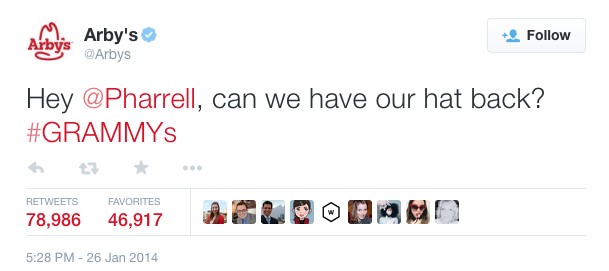
One of the biggest newsjacking winners in 2014 was Arby’s when they managed an unexpected connection to the Grammys and nearly 80,000 retweets. After an hour or so of comments by Twitter users on Pharrell Williams’ hat’s resemblance to the Arby’s headgear, the brand tweeted, “Hey @Pharrell, can we have our hat back?” The brand’s quick thinking launched a Twitter frenzy culminating in the superstar musician’s response: “Y’all tryna start a roast beef?”
Newsjacking, while potentially profitable in boosting fans and profits, requires a critical eye to determine whether there’s a tasteful way to newsjack breaking events. Although there have been plenty of brands that have managed to successfully newsjack emotionally charged news items, there have been some major fails.
Think back to 2010 when 33 Chilean miners were trapped underground for 69 days. When those miners surfaced in front of thousands of cameras and millions watching at home, their eyes, which had been exposed to extreme darkness for more than two months, were donning $450-a-pop Oakley sunglasses.
By all accounts, the newsjack landed Oakley $41 million in equivalent advertising — free. Subsequent reactions were mixed, with some people saying Oakley took advantage of a situation and calling the stunt “despicable.”
Most of the ugliest newsjacking fails have been tied to “loaded” holidays, anniversaries, and issues like 9/11, Martin Luther King Jr’s birthday, or sex scandals (we’re looking at you Mini and your failed Anthony Weiner newsjack).
During 2012’s tragic Hurricane Sandy, plenty of brands committed terrible faux pas, with Sears pushing generators and air mattresses on Twitter and Urban Outfitters distastefully saying, “This storm blows (but free shipping doesn’t)!”
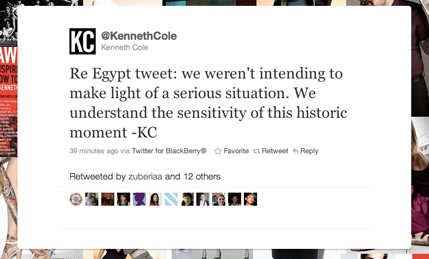
Urban Outfitters was in line with Kenneth Cole’s 2011 newsjacking fail with the unfortunate formula in newsjacking that involves an irrelevant offer added to the end of a tweet without any clear connection. The original Arab Spring tweet read: “Millions are in uproar in #Cairo. Rumor is they heard our new spring collection is now available online” and prompted a now-defunct parody account @KennethColePR with tweets like “People from New Orleans are flooding into Kenneth Cole stores!”
Despite attempts at being clever, many of the worst attempts at newsjacking did more harm to the brand than good, no matter how many giggles the efforts might have gotten on the fly. Successful newsjacking means thinking on your feet in the short term, but with your brand’s long-term marketing strategy and vision in mind.
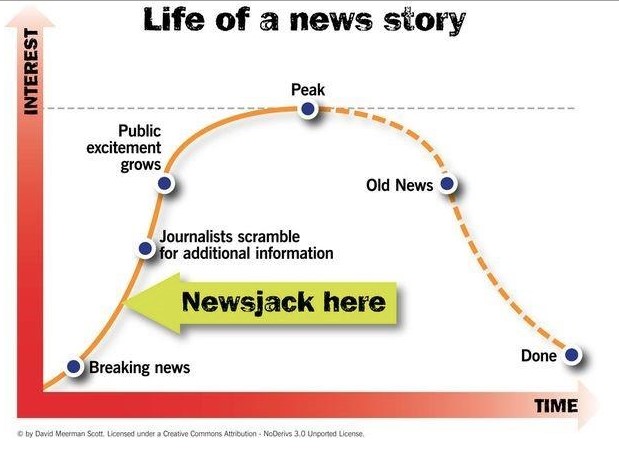
In addition to having a critical, sensitive eye, brand marketers also need a keen awareness of current digital trends, memes, and etiquette to manage its newsjacking efforts. There’s nothing like an outdated meme (Keep Calm and ______) tackling a breaking news story; it’s asking for failure and rough criticism from social media users and experienced brand managers.
Newsjacking can boost your brand or further an important cause or it can be the harbinger of unending berating from the social sphere. You can bring a bit of humor to a dismal Super Bowl blackout, or you can sink your brand’s integrity in a mere 140 characters — curate your brand’s real-time creativity carefully.